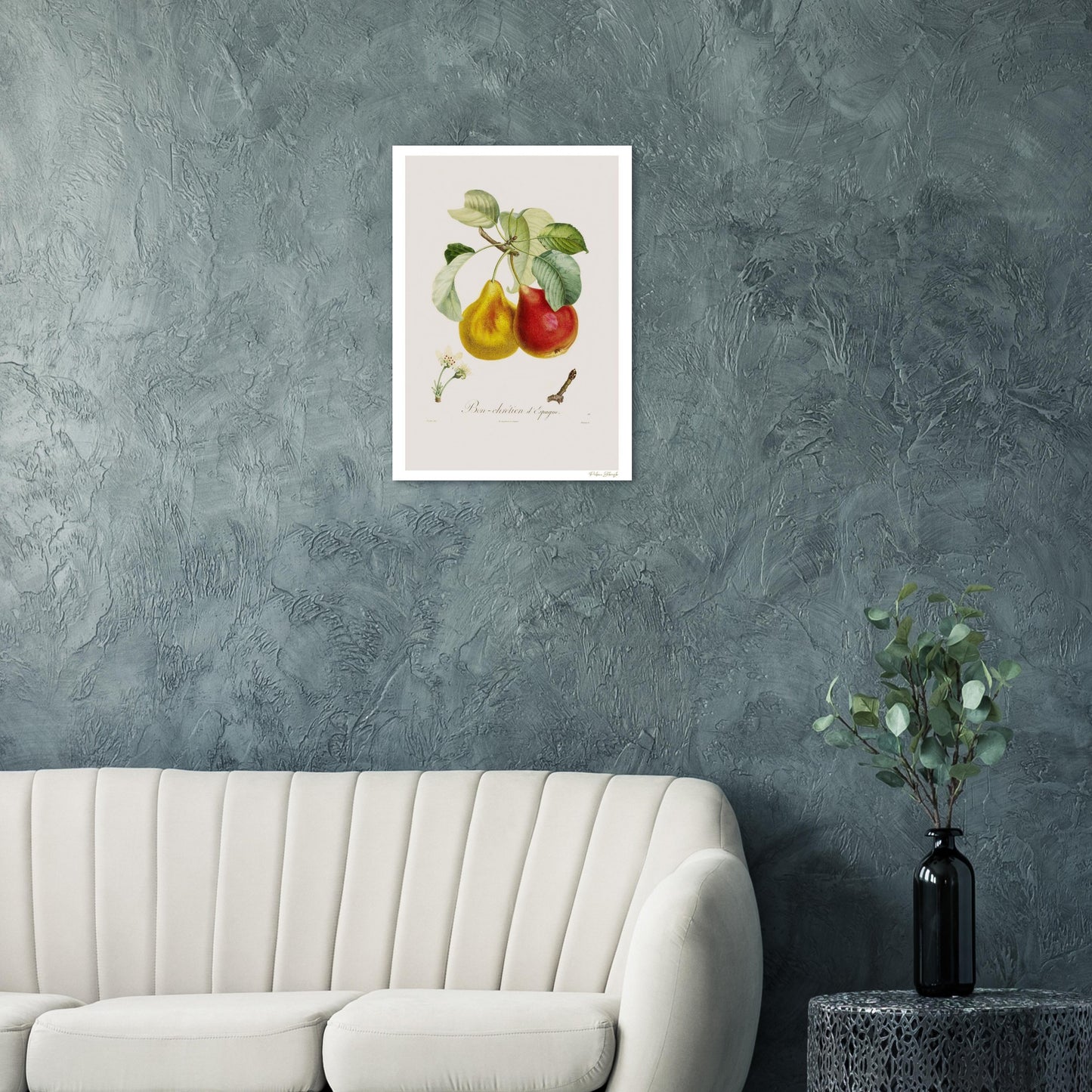
Bon-Chrétien d'Espagne - Botanical poster 50x70cm
Bon-Chrétien d'Espagne - Botanical poster 50x70cm
Couldn't load pickup availability
Share
Pyrus Hispanica, Spanish Bon Chrétien Pear
"One could hardly resist it": so said La Quintinye, gardener to Louis XIV, in the face of this spectacular pear that so perplexed him.
Large, elegantly pyramidal, adorned with a vermilion red dotted with black specks, the Spanish Bon Chrétien captivated with its beauty but divided connoisseurs. Merlet proclaimed it delicate, while La Quintinye relegated it to the 266th rank of his fruit garden, criticizing its "harsh, coarse, and stony" flesh.
Eighty years later, Duhamel tempered the judgment: cultivated in good soil, with good exposure, it could prove sweet and succulent. This controversy provides the historical flavor of this fruit: a symbol of the demands of the royal table and the passionate debates among pomologists.
A large, elongated pear in a perfect pyramid shape, the Spanish Bon Chrétien is distinguished by its vibrant red on one side and yellowish-white on the other.
Its white flesh, speckled with greenish dots, is crisp; a characteristic that La Quintinye detested immensely. Depending on the terroir and the year, it could prove dry and hard, or on the contrary, tender and filled with sweet, fresh water.
Harvested from mid-November to mid-December, sometimes until January, it required light, dry soil and good sunlight to reach its perfect ripeness.
Excellent in compote, it could also be eaten raw when "well conditioned". Its name comes from its striking resemblance to the famous winter Bon Chrétien, and while La Quintinye grudgingly admitted that "it looks good in the ornament of pyramids," Duhamel esteemed it more, recognizing that it was among the most beautiful pears of his time.
This plate is taken from the Traité des Arbres Fruitiers by Pierre-Antoine Poiteau and Pierre Jean François Turpin, a botanical encyclopedia published between 1807 and 1835, a major reference in 19th-century naturalist illustration.
It combines the rigor of scientific drawing with a rare artistic sensibility, characteristic of the great plates from the golden age of illustrated botany.
- Each poster is printed with 12-color giclée printing, the benchmark for art workshops for reproducing fine tones, subtle gradients, and the most delicate botanical details.
- Weight 200 g/m², soft matte finish, thickness 0.26 mm: a rendering close to the original engraving, clear, non-reflective, designed for hanging.
- Printed on FSC certified paper, produced individually upon order.
- Shipped in a rigid protective tube.