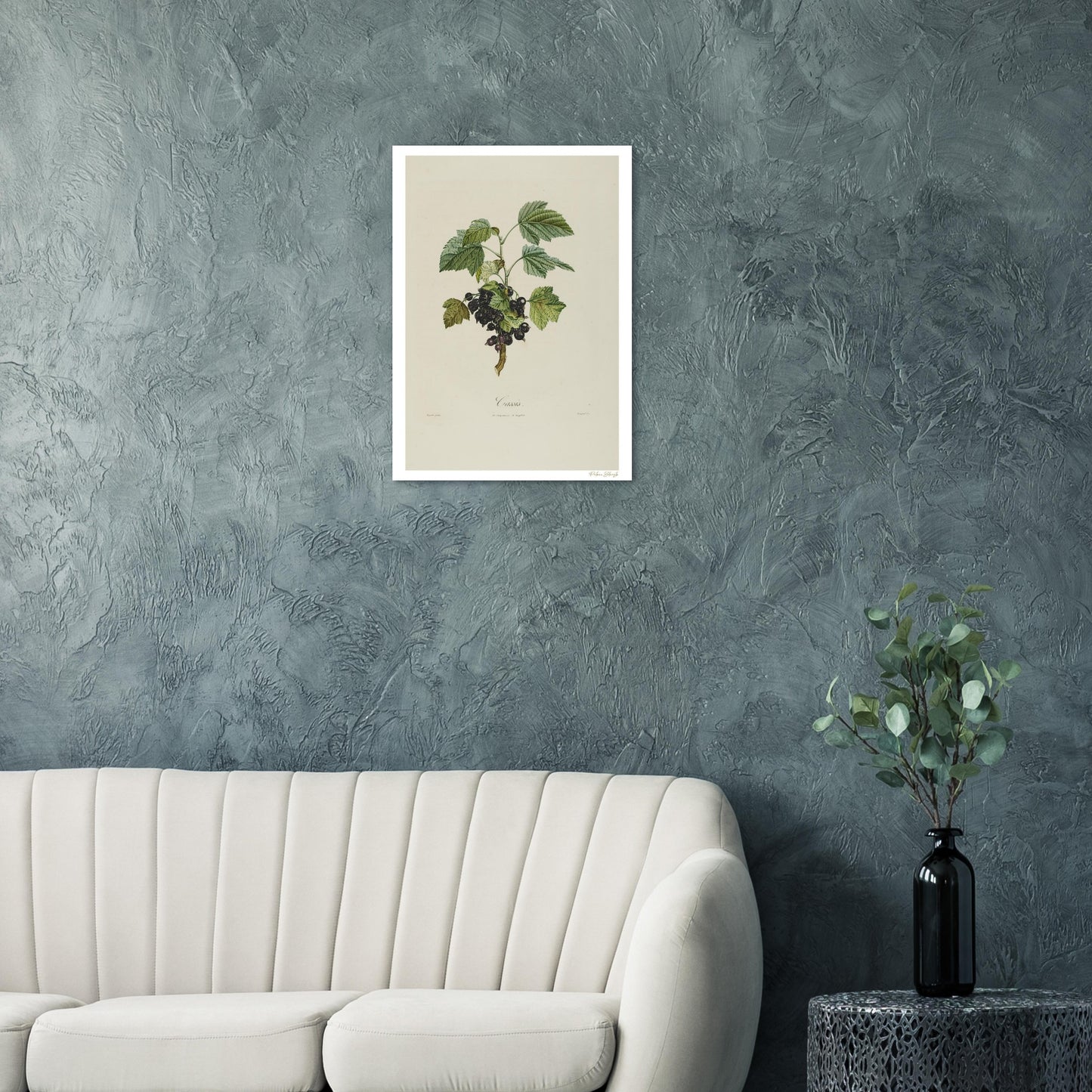
Blackcurrant - Botanical print 50x70cm
Couldn't load pickup availability
Share
Ribes nigrum - Blackcurrant
Originally from Sweden and Switzerland, blackcurrant was long cultivated around Paris as much for its medicinal properties as for its renowned digestive liqueur.
This plate illustrates a singular shrub: all its parts emit a powerful odor which, while off-putting to some, naturally protects the plant from insect pests.
In the 18th century, the Irish were already infusing the berries in grain alcohol to make a punch recommended for colds and sore throats; a use that earned the fruit its nickname "quinsy berry".
The shrub, whose stems reach 1 to 2 meters but are usually pruned shorter, has a blackish bark on old branches and powdery fawn on young shoots.
Its leaves, 8 to 12 cm wide, are cut into five unequal lobes ending in glandular teeth; their underside bears golden glands to which the plant's medicinal properties are attributed.
The greenish flowers, washed with a slight purple tint, are organized in hanging clusters less abundant than those of the redcurrant.
The fruit, a very dark blackish-purple, ripens in June-July; its hard skin, dotted with white spots, releases a brilliant bright red dye when crushed. The melting, bluish-white flesh contains ten to twenty angular seeds.
While the berries are rarely consumed fresh, an excellent syrup for throat ailments and a digestive liqueur that "tempers the ardor of the stomach" without heating like ordinary spirits are derived from them. Infused leaves, aperitif and stomachic, relieve indigestion.
This plate is extracted from Traité des Arbres Fruitiers by Pierre-Antoine Poiteau and Pierre Jean François Turpin, a botanical encyclopedia published between 1807 and 1835, a major reference in 19th-century naturalist illustration.
It combines the rigor of scientific drawing with a rare artistic sensitivity, characteristic of the great plates of the golden age of illustrated botany.
- Each poster is printed using 12-color giclée printing, the benchmark for art workshops for the reproduction of fine tones, subtle gradients, and the most delicate botanical details.
- 200 g/m² paper weight, soft matte finish, 0.26 mm thickness: a result close to the original engraving, clear, glare-free, designed for hanging.
- Printed on FSC certified paper, printed individually to order.
- Shipped in a rigid protective tube.