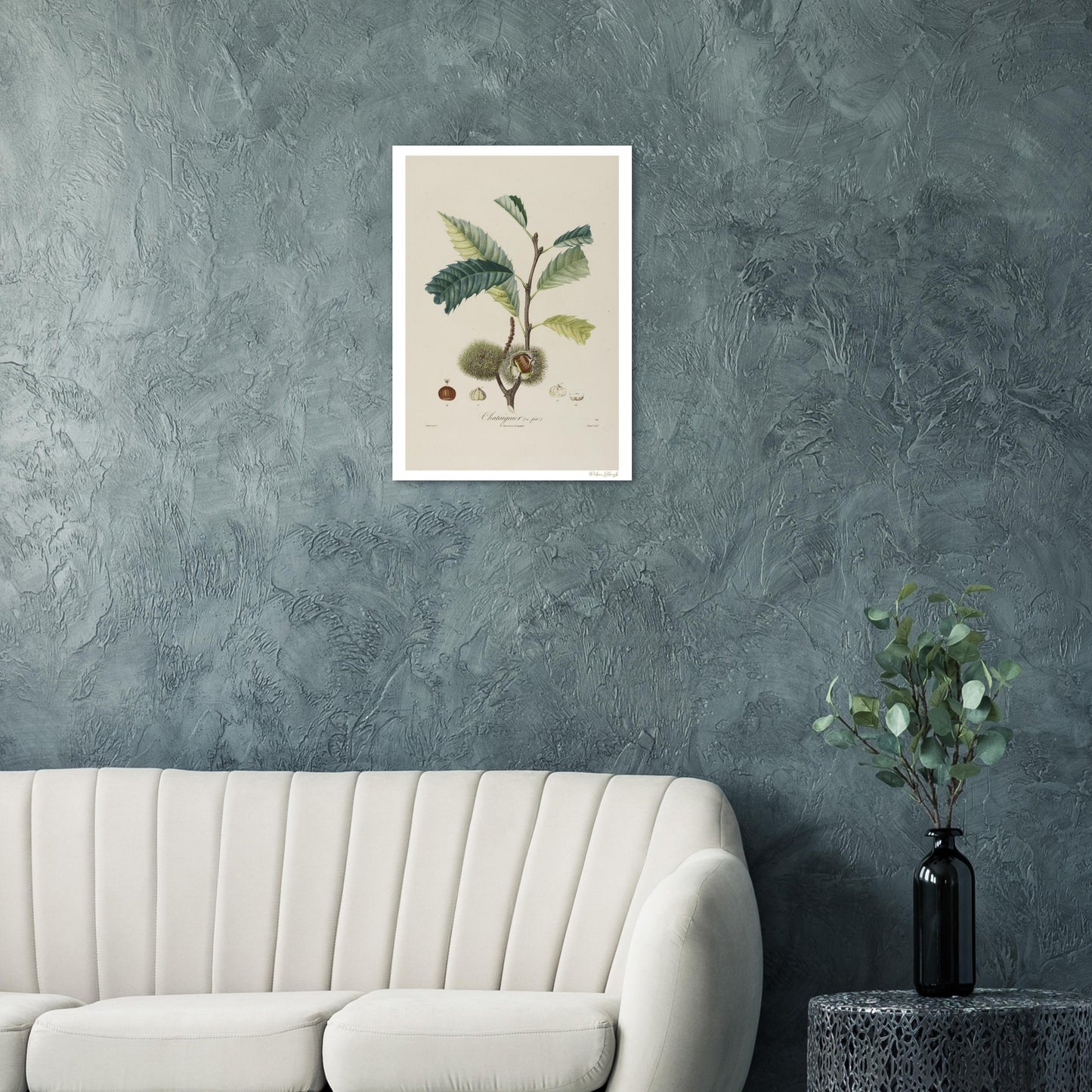
Common Chestnut - Botanical poster 50x70cm
Couldn't load pickup availability
Share
Castanea vulgaris, Sweet Chestnut
The sweet chestnut once graced the woods of Montmorency and Meudon with its majestic stature, the elegance of its leaves, and its long spikes of yellowish flowers that bloomed in mid-July, despite their not-so-pleasant scent.
In the Parisian climate, its fruits ripened in October and November, encased in their famous spiny husk which opened at the first frosts to release two or three chestnuts.
Poiteau slyly notes that these fruits, reserved for children and wild animals, always found takers despite their defensive prickles.
Sweet chestnut flowers, axillary and rarely terminal, emerge with the year's growth.
Its fruit ripens late: in cold autumns, the husk sometimes falls closed, its chestnuts still trapped inside.
The following spring, around April, the flesh of the chestnuts undergoes a natural fermentation that makes it sweeter before losing its taste qualities.
If Lyon marron varieties are grafted onto the common sweet chestnut, larger chestnuts are obtained, but never true marrons, whose storage was located in Limours, seven leagues from Paris.
The tree grows faster than the oak and resembles it in its wood when young, but after fifty or sixty years, its woody layers easily exfoliate, making it unsuitable for large timber framing.
Fortunately, the sweet chestnut thrives in the most ungrateful soils: sterile sands, uncultivable slopes. Cultivated as coppice, cut every ten or twenty years for barrel hoops, vine stakes, or light frameworks, it constitutes a valuable resource.
This plate is taken from Pierre-Antoine Poiteau and Pierre Jean François Turpin's Traité des Arbres Fruitiers (Treatise on Fruit Trees), a botanical encyclopedia published between 1807 and 1835, a major reference in 19th-century naturalistic illustration.
It combines the rigor of scientific drawing with a rare artistic sensibility, characteristic of the great plates from the golden age of illustrated botany.
- Each poster is printed using 12-color giclée printing, the benchmark for art studios for rendering fine tones, subtle gradients, and the most delicate botanical details.
- 200 gsm paper, soft matte finish, 0.26 mm thick: a result close to the original engraving, clear, non-reflective, designed for hanging.
- Printed on FSC-certified paper, individually printed to order.
- Shipped in a rigid protective tube.