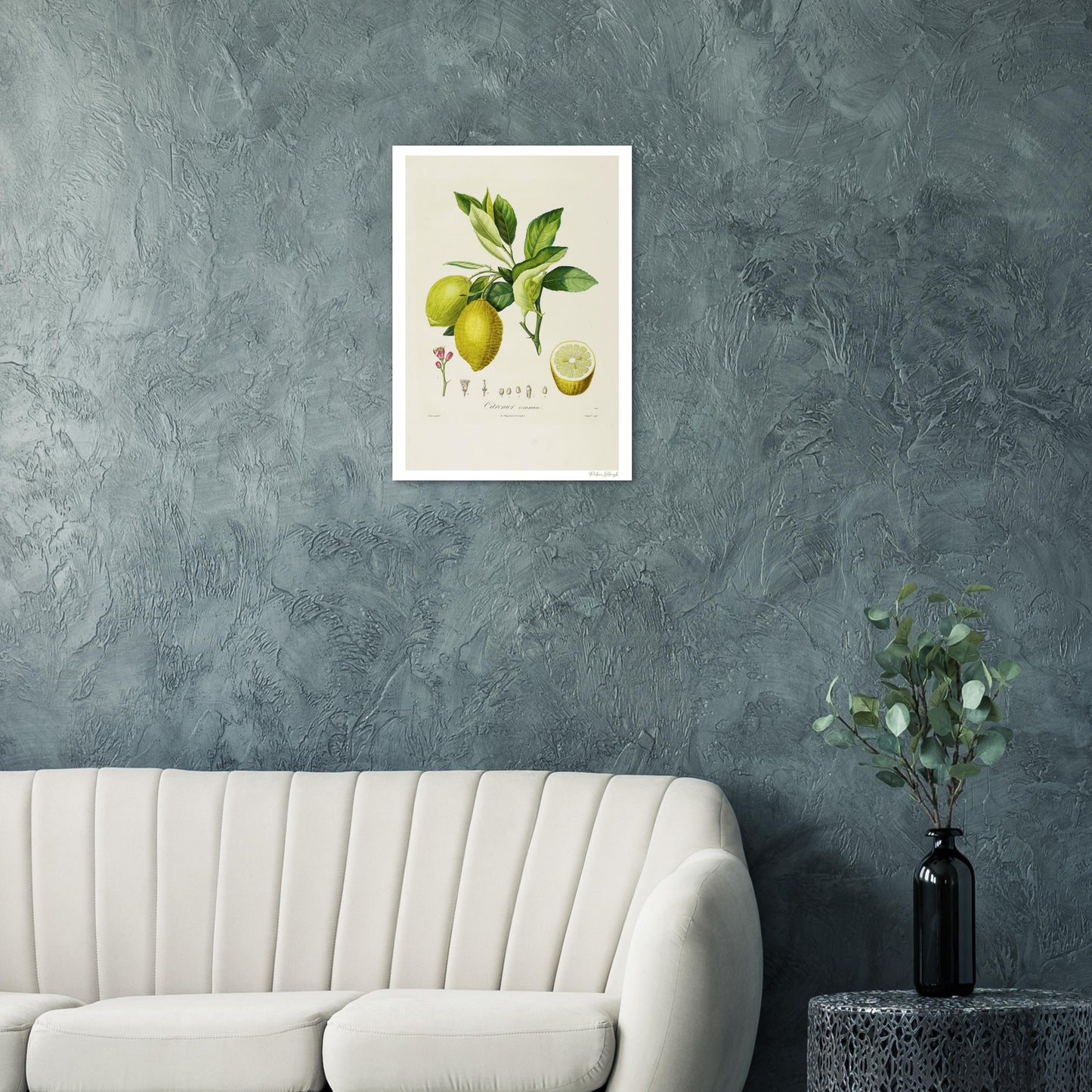
Common Lemon Tree - Botanical poster 50x70cm
Couldn't load pickup availability
Share
Citrus limon, Common Lemon Tree
Should we say "limon" rather than "citron"? Poiteau playfully discusses this linguistic quarrel: if we say "limonade" (lemonade) and "limonadier" (lemonade vendor), why not call the fruit itself "limon"? It seems a certain Italian who came to Paris to establish the first lemonade stand imposed his word "Limonea," while, out of national pride, the French kept the name "citron." Thus, "citronnier" (lemon tree) and "limonier" (lemon tree) are synonyms, but the latter, Poiteau slyly tells us, is better than the former.
The lemon tree is distinctly different from the orange tree in its habit: almost always thorny, it bears long, diverging, and sparsely branched shoots.
Its leaves, with wingless petioles, and its flowers, tinged with red on the outside and exhaling a very discreet fragrance, make it a distinct species. Its stamens, numbering about twenty and grouped in bundles, classify the genus in the polyadelphia of Linnaeus's sexual system.
As for the fruit, everyone knows the lemon: its bright yellow color, its characteristic ovoid shape, and the pleasant acidity of its juice. The most highly esteemed lemons are those with the thinnest rind. Inside, the fruit is divided into eight to ten segments filled with vesicles engorged with juice and seeds attached to the central angle of each segment.
Poiteau specifies that citrus seeds exhibit a rare anatomical complication, which he took care to detail in his plates.
This plate is taken from Poiteau and Turpin's Traité des Arbres Fruitiers, a botanical encyclopedia published between 1807 and 1835, a major reference for 19th-century naturalist illustration.
It combines the rigor of scientific drawing with a rare artistic sensibility, characteristic of the great plates from the golden age of illustrated botany.
- Each poster is printed using 12-color giclée printing, the standard for art studios for the reproduction of fine tones, subtle gradients, and the most delicate botanical details.
- 200 g/m² paper weight, soft matte finish, 0.26 mm thickness: a rendering close to the original engraving, clear, non-reflective, designed for hanging.
- Printed on FSC-certified paper, produced individually to order.
- Shipped in a rigid protective tube.