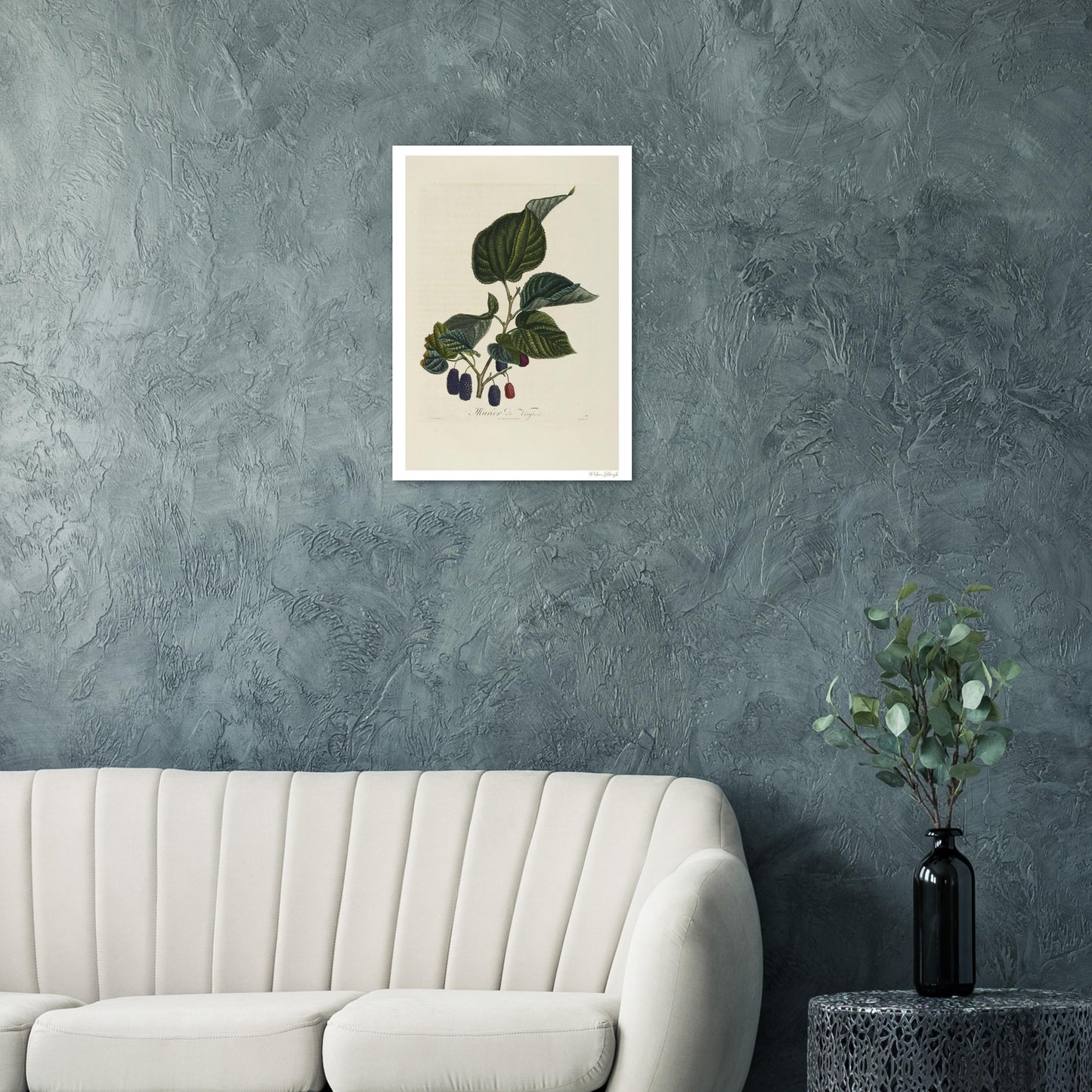
Virginia Mulberry - Botanical print 50×70 cm
Virginia Mulberry - Botanical print 50×70 cm
Couldn't load pickup availability
Share
Morus rubra - Red Mulberry
When the first specimens of this North American tree were introduced to Europe, the English botanist Rai mistook them for hazelnut trees: he only saw male catkins and was unaware that the species could be dioecious by abortion.
It took several decades before female individuals finally revealed their fruits and it was understood that Red Mulberry and Virginia Mulberry designated one and the same species.
This botanical misunderstanding testifies to the initial rarity of fruiting trees, to the point that Poiteau himself, in the 1840s, no longer saw the strong individuals in the Jardin du Roi that, thirty years earlier, produced these much-prized mulberries.
The Red Mulberry surpasses the black mulberry in size and vigor. Its wood, harder and denser, was reputed suitable for construction.
Its leaves, large and heart-shaped, end in a point and have an irregular saw-like dentition. Rough on the surface, hairy and reticulate on the underside, they are rarely flat, often bent or twisted. On vigorous young shoots, they divide into three or five lobes.
The yellowish, loosely packed male catkins fall quickly after pollen emission. The female catkins, initially green, then enlarge and become succulent. They lengthen up to 41 millimeters, take on a cylindrical shape, and sag under their own weight.
Changing from green to red, from red to purple, then to black at full ripeness, they form mulberries with a fine taste, enhanced by a pleasant acidity absent from the black mulberry. They ripen fifteen days before the latter.
This plate is taken from Pierre-Antoine Poiteau and Pierre Jean François Turpin's Traité des Arbres Fruitiers, a botanical encyclopedia published between 1807 and 1835, a major reference in 19th-century naturalist illustration.
It combines the rigor of scientific drawing with a rare artistic sensibility, characteristic of the great plates of the golden age of illustrated botany.
- Each poster is printed using 12-color giclée printing, the benchmark for art studios for rendering fine tones, subtle gradations, and the most delicate botanical details.
- 200 g/m² weight, soft matte finish, 0.26 mm thickness: a rendering close to the original engraving, sharp, glare-free, designed for display.
- Printed on FSC-certified paper, individually printed to order.
- Shipped in a rigid protective tube.