Skip to product information
1 of 8

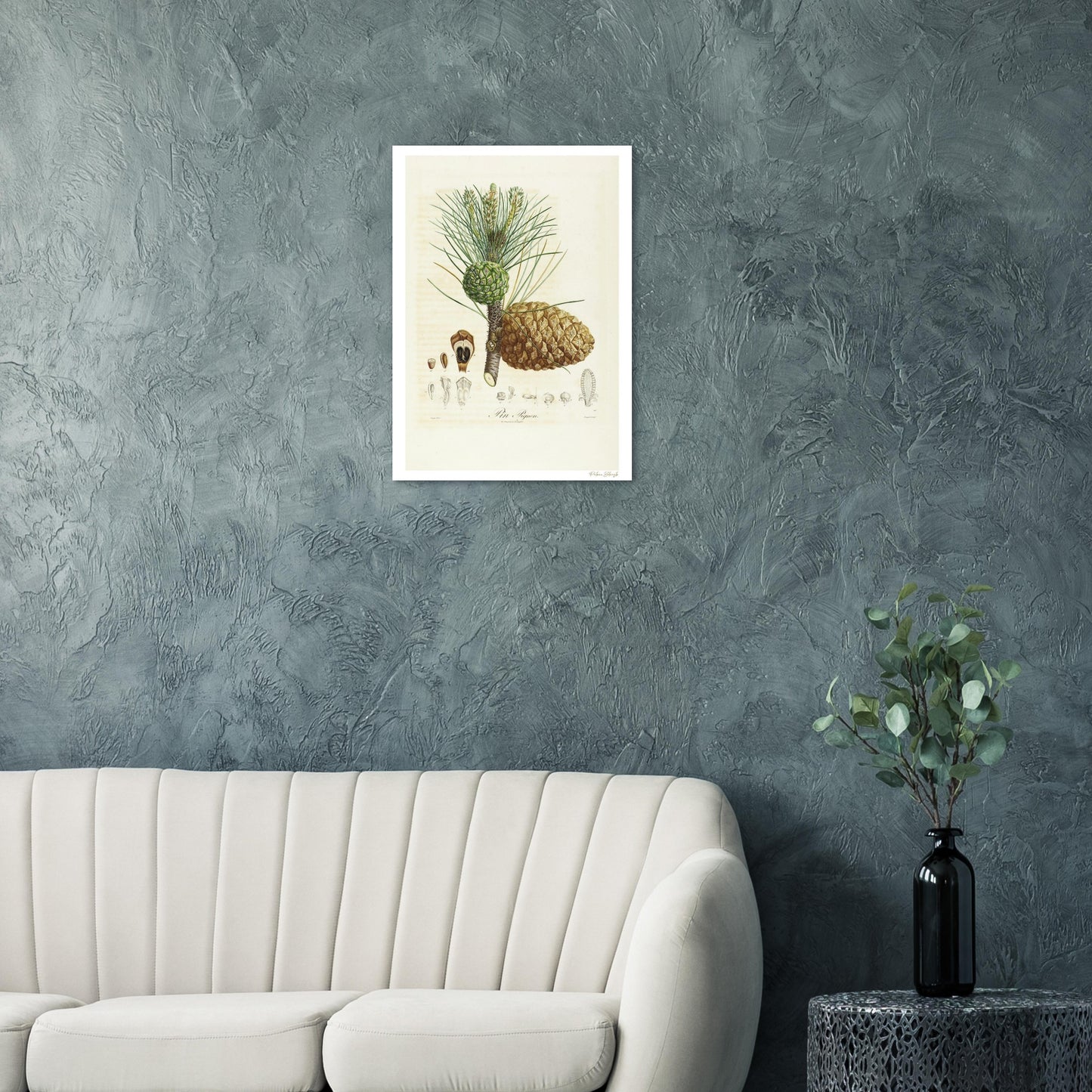
Stone Pine - Botanical print 50x70cm

Stone Pine - Botanical print 50x70cm

Regular price €32,50 EUR
Regular price Sale price €32,50 EUR
Sale Sold out
Taxes included. Shipping calculated at checkout.
Quantity

Pinus pinea - Stone Pine

The Stone Pine stands out from all other pines due to its unique silhouette: its crown does not rise to a point but spreads out into a wide, horizontal, and flattened canopy, a characteristic profile that landscape painters have long favored for its picturesque value.

This singular architecture, combined with a massive trunk at the base that rapidly tapers towards the top, makes this tree a true signature of Mediterranean landscapes.

Naturally found in the mountains of southern France and the Bordeaux moors, the Stone Pine gets its vernacular name from its seeds: pine nuts, enclosed in an extremely hard shell, mature in large, regular cones that take four full years to ripen.

The reddish bark of the trunk features large longitudinal fissures, sometimes arranged spirally, suggesting a natural twisting of the wood fibers.

The leaves, arranged in pairs and 12 to 15 centimeters long, are semi-cylindrical, striated, and finely toothed along their edges. Young plants first produce simple, solitary leaves, which Poiteau described as "primordial," before developing their characteristic paired needles.

Flowering occurs in June: the reddish-yellow male catkins produce a prodigious amount of pollen, those famous "sulfur rains" that once fell on Bordeaux.

The female cones, shaped like a brazier, grow slowly to reach 15 to 18 centimeters. Inside, each scale houses two pine nuts with a bony shell. The white almond they contain, half fleshy and half crumbly, offers a sweet and pleasant flavor. Consumed plain or candied in dragees and pralines, it also provides a delicate oil, comparable to that of hazelnuts, although prone to rancidity.

This plate is taken from Pierre-Antoine Poiteau and Pierre Jean François Turpin's Traité des Arbres Fruitiers, a fruit encyclopedia published between 1807 and 1835, a major reference in 19th-century naturalistic illustration.

It combines the rigor of scientific drawing with a rare artistic sensibility, characteristic of the great plates from the golden age of botanical illustration.

Printing, support, shipping
  • Each poster is printed using 12-color giclée printing, the reference for art workshops for rendering fine tones, subtle gradients, and the most delicate botanical details.
  • 200 gsm paper, soft matte finish, 0.26 mm thick: a finish close to the original engraving, clear, non-reflective, designed for hanging.
  • Printed on FSC certified paper, produced individually upon order.
  • Shipped in a rigid protective tube.
View full details