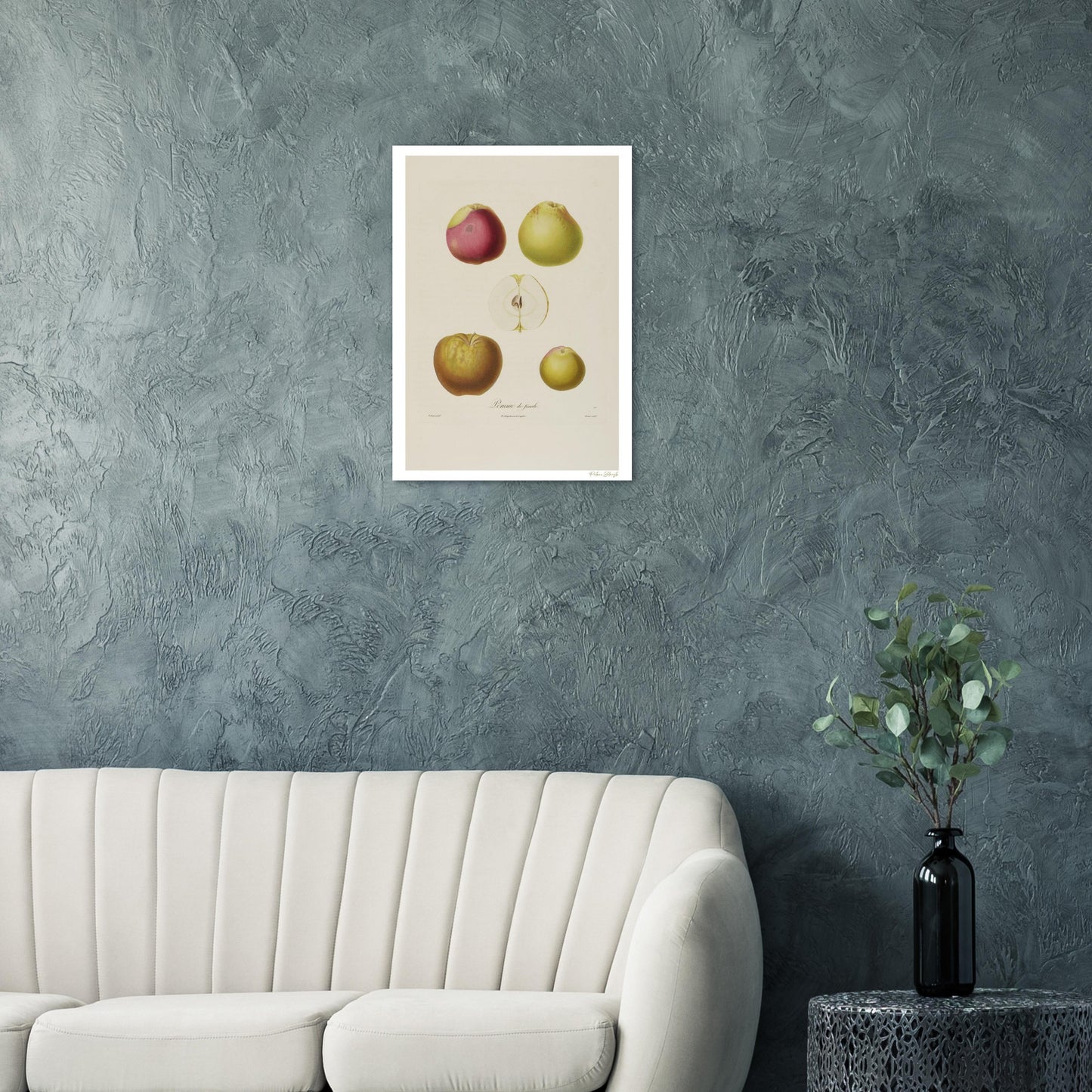
Finale Apple - Botanical Poster 50x70cm
Couldn't load pickup availability
Share
Malus Caroli – Finale Apple
In 1810, the Italian botanist Gallesio, convinced that no French apple could compare to the varieties from his own country, had a crate of Finale Apples brought from Italy and distributed them to a select few Parisians.
Pierre-Antoine Poiteau was one of them. Charmed by the excellence of this fruit, he immediately included it in his Traité des Arbres Fruitiers.
This apple, named after the city of Finale in the region of Genoa where it was particularly cultivated, was so highly esteemed that it was shipped as far as Portugal in compartmentalized crates.
The anecdote recounts that an apple, forgotten during an unpacking and returned to Genoa a year later, was still "perfectly sound and very good to eat," exceptional testimony to its preservation capabilities.
The Finale Apple, also known as Charles' Apple in Italy, is distinguished by its great variability in shape, size, and color. It always tapers towards the top, where a narrow indentation bordered by ribs houses a tiny, closed eye. Its long, slender stem is inserted into a narrow, deep cavity.
Its skin, initially almost white, smooth, and remarkably resistant despite its thinness, takes on a light red hue on the side exposed to the sun, sprinkled with a few yellow dots.
From November-December, russet spots gradually appear, extending to almost entirely cover the fruit by May-June, a natural phenomenon that does not alter the flesh in any way.
The flesh remains white, extremely fine, melting, with a delicious fragrance and pleasantly tart juice. The locules, small to medium-sized, each contain two short, compressed, brown seeds.
This plate is taken from Pierre-Antoine Poiteau and Pierre Jean François Turpin's Traité des Arbres Fruitiers, a botanical encyclopedia published between 1807 and 1835, and a major reference in 19th-century naturalist illustration.
It combines the rigor of scientific drawing with a rare artistic sensibility, characteristic of the great plates from the golden age of illustrated botany.
- Each poster is printed using 12-color giclée printing, the benchmark for art studios for reproducing fine tones, subtle gradients, and the most delicate botanical details.
- 200 gsm paper, soft matte finish, 0.26 mm thickness: a result close to the original engraving, sharp, glare-free, designed for hanging.
- Printed on FSC certified paper, individually printed to order.
- Shipped in a rigid protective tube.