Skip to product information
1 of 8

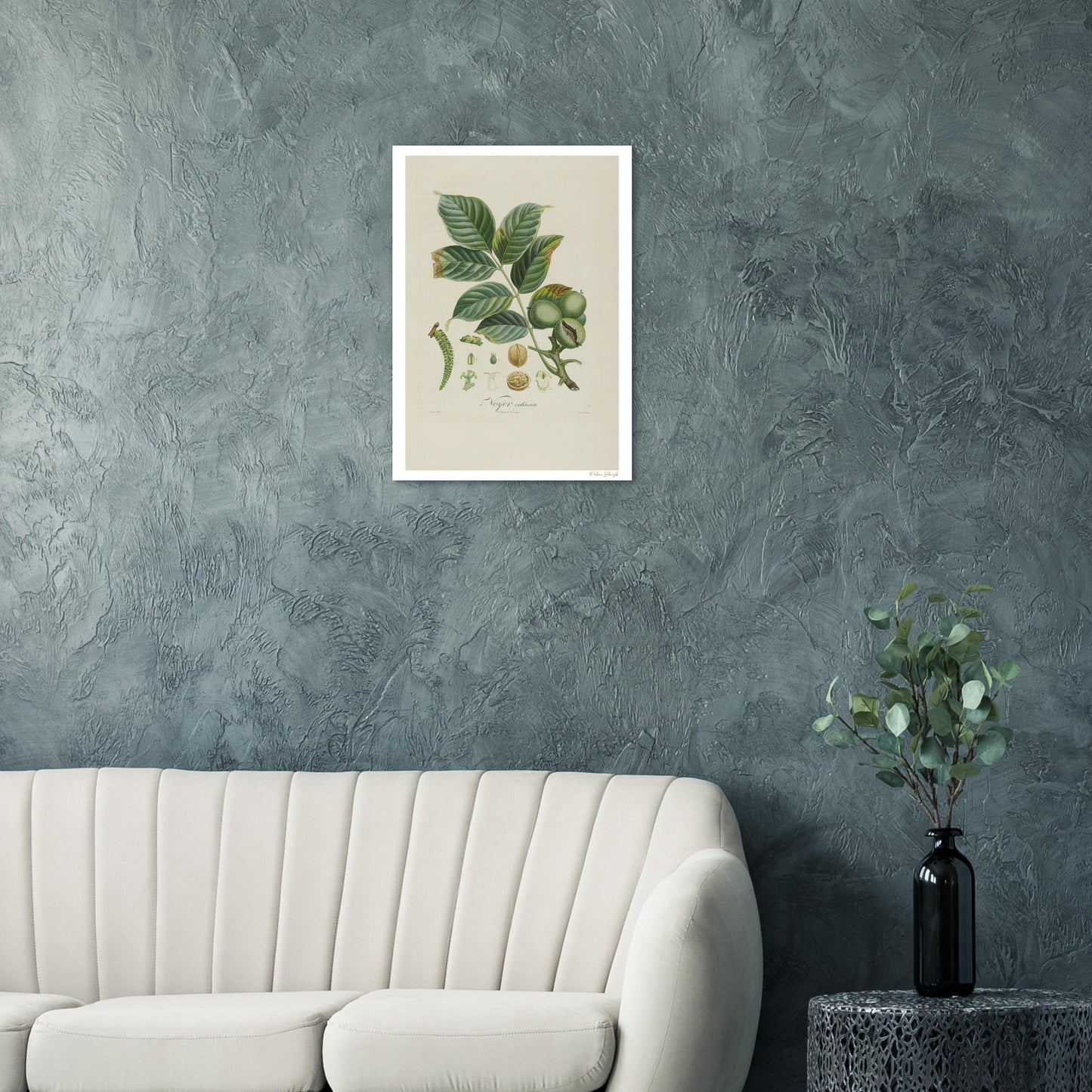
Common Walnut - Botanical Fine Art Print 50x70cm

Common Walnut - Botanical Fine Art Print 50x70cm

Regular price €32,50 EUR
Regular price Sale price €32,50 EUR
Sale Sold out
Taxes included. Shipping calculated at checkout.
Quantity

Juglans regia - Common Walnut

The terrible winter of 1709 decimated France's walnut trees. That of 1788 left them with deep cracks that weakened their growth for decades.

Yet, the walnut tree has endured through the centuries: a tree of legend and contradiction, it offers precious wood to cabinetmakers and sculptors, an oil with multiple virtues, sought-after fruits… while reigning alone, tolerating no cultivation at its feet.

This plate by Poiteau captures the botanical majesty of a giant that grows for eighty years and can live for two centuries.

A large tree of the family Anacardiaceae, native to Asia, the walnut tree is recognizable by its alternate and winged leaves, its male flowers arranged in catkins, its female flowers grouped in threes to twenties at the end of the shoots.

Its fruit, the walnut, consists of a fleshy husk enclosing a bony shell that houses the four-lobed kernel. Formidable for its dense shade and invasive roots, the walnut tree demands isolation: neither cereals nor fruit trees thrive in its vicinity.

It is destined for stony slopes exposed to the setting sun, for the edges of pastures, for crossroads where it reigns supreme.

It takes ten to fifteen years for its first fruits, sixty years for its full yield.

Its wood, sought after by joiners and coachbuilders, never warps once dry. Its dried catkins treat dysentery, its oil is used in medicine and painting, and fresh walnuts, the kernels, stimulate appetite, although those with fragile chests should be wary.

This plate is extracted from Traité des Arbres Fruitiers by Pierre-Antoine Poiteau and Pierre Jean François Turpin, a botanical encyclopedia published between 1807 and 1835, a major reference in 19th-century naturalist illustration.

It combines the rigor of scientific drawing with a rare artistic sensibility, characteristic of the great plates from the golden age of illustrated botany.

Printing, media, shipping
  • Each poster is printed with 12-color giclée printing, the benchmark for art workshops for rendering fine tones, subtle gradients, and the most delicate botanical details.
  • 200 gsm paper weight, soft matte finish, 0.26 mm thickness: a rendering close to the original engraving, sharp, without reflections, designed for hanging.
  • Printed on FSC certified paper, produced individually on demand.
  • Shipped in a rigid protective tube.
View full details